Celebrating the Summer Solstice at Stonehenge: A Guide to the Ultimate Sunrise Experience
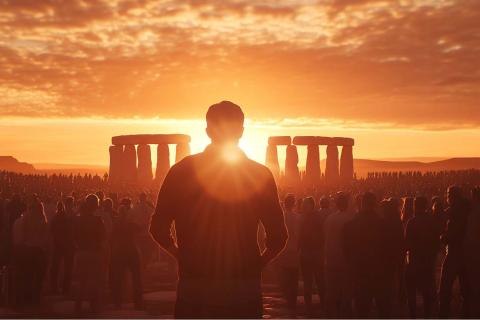
Witnessing the summer solstice at Stonehenge is a bucket-list experience that blends ancient mystery, spiritual energy, and the awe of standing where humans have gathered for over 5,000 years.
A Timeless Sentinel on Salisbury Plain
On the windswept expanse of Salisbury Plain in Wiltshire, England, where the land stretches wide under endless skies, stands Stonehenge, a silent sentinel of ancient secrets. For over 5,000 years, this ring of towering stones has guarded its mysteries, drawing pilgrims, scholars, and wanderers into its orbit. Its story is etched not just in the weathered sarsens and bluestones but in the very soul of the landscape.
The Landscape: A Tapestry of Ancient Wonders
Stonehenge rises from the chalky grasslands of southern England, a stark silhouette against the horizon. To the north, the medieval spire of Salisbury Cathedral pierces the sky, while the sleepy town of Amesbury nestles nearby. This is no isolated monument but the heart of a vast archaeological tapestry. Scattered across the plain are burial mounds, ancient pathways, and the remnants of Neolithic villages like Durrington Walls, where the builders of Stonehenge may once have lived. The land itself seems alive with memory, whispering of rituals performed under star-strewn skies and solstice sunrises that have ignited human wonder for millennia.
A Journey Through Time: The Layers of Stonehenge
The story of Stonehenge begins around 3000 BCE, long before the pyramids of Egypt or the rise of Rome. Its construction unfolded in waves, each phase a testament to the ingenuity and resolve of its creators.
First came the circular ditch and bank, carved into the earth with antler picks and stone tools. Within this sacred enclosure, early communities buried their dead, leaving behind cremated remains in pits now known as the Aubrey Holes. These ancestors, perhaps chieftains or priests, became the first guardians of the site.
Centuries later, the bluestones arrived, a puzzle still unsolved. Quarried from the Preseli Hills in Wales, over 140 miles away, these smaller stones were dragged, floated, or sledged across rivers and valleys. Their journey, a feat of prehistoric engineering, hints at a purpose profound enough to justify the labor: were they talismans of healing, symbols of unity, or keys to celestial alignments?
By 2500 BCE, the monument took its iconic form. Colossal sarsen stones, hauled from the Marlborough Downs, were shaped into trilithons, two uprights capped by a lintel, and arranged in a horseshoe and outer circle. The Heel Stone, planted to the northeast, framed the summer solstice sunrise, casting its first golden rays into the heart of the circle. For generations, Stonehenge evolved, a living temple, a celestial clock, a bridge between earth and sky.
Spirituality: Echoes of the Ancients
To stand among the stones is to feel the weight of centuries of reverence. The Neolithic builders likely gathered here to mark the solstices, their rituals intertwined with the cycles of planting and harvest. The summer solstice sunrise, spilling light through the Heel Stone, would have symbolized rebirth; the winter solstice sunset, a promise of light’s return. For them, Stonehenge was not just a monument but a conduit to the divine, a place where the living communed with ancestors and gods.
Over time, new voices layered meaning onto the stones. The Celts, arriving millennia later, wove their own myths. Medieval chroniclers claimed Merlin himself raised the stones with magic. By the 18th century, Druids, (modern revivalists, not the ancient priests) claimed Stonehenge as their temple, cloaking it in romantic ritual. Today, their descendants gather at solstice dawn, robed in white, chanting as drums echo across the plain.
Yet Stonehenge resists easy definition. Some feel its energy as a vortex, a node on ley lines pulsing with earthly power. Others find stillness in its shadows, a space to ponder humanity’s smallness beneath the cosmos. For all, it is a mirror, reflecting not just who we were, but who we aspire to be.
The Modern Pilgrimage that Unites
Each year, as the solstice sun approaches, thousands converge on Salisbury Plain. They come in tie-dye and hiking boots, with cameras and sage bundles, drawn by a pull they cannot always name. On the eve of the summer solstice, the air thrums with anticipation. Drum circles rise and fade; laughter mingles with the scent of damp grass. As dawn breaks, a hush falls, the sun, faithful as ever, spills its light through the stones. In that moment, time collapses. A Neolithic priest, a Victorian antiquarian, and a 21st-century traveler stand shoulder to shoulder, united by wonder.
Why Stonehenge for the Summer Solstice
The prehistoric stone circle is perfectly aligned with the summer solstice sunrise. On June 21, the first rays of sunlight pierce the Heel Stone and flood the center of the monument—a spectacle engineered by Neolithic builders around 3000 BCE.
Sacred Significance: For pagans, druids, and spiritual seekers, the solstice marks the peak of light, symbolizing renewal, growth, and connection to nature.
What to Expect in 2025
Dates: Sunset on June 20 and sunrise on June 21, 2025
Access: Unlike regular visits, the stones are open to the public during solstice celebrations. Walk among the megaliths and touch their ancient surfaces.
Atmosphere:
-
Sunset Vigil (June 20): Drum circles, chanting, and a peaceful crowd awaiting dawn.
-
Sunrise Moment (June 21, ~4:45 AM): A hushed silence as the sun crests the horizon, followed by cheers and applause.
Practical Tips for Visitors
-
Entry is FREE, but parking fees apply (£25 per car, book in advance).
-
Arrive Early: Gates open at 7 PM on June 20. Expect crowds—up to 30,000 people attend!
-
What to Bring:
-
Warm layers (temperatures drop at night).
-
A flashlight (red-tinted to preserve night vision).
-
A reusable water bottle and snacks (no alcohol allowed).
-
A blanket or portable chair.
-
-
Dress Code: Weather-proof everything! Rain or shine, the show goes on.
Respect the Site
-
No climbing on the stones.
-
Leave no trace: Pack out trash (bins are limited).
-
Quiet zones: Respect meditative spaces set aside for druids and spiritual groups.
Local Culture & Nearby Gems
Salisbury: Visit the medieval city (15 minutes away) and its iconic Salisbury Cathedral, home to the Magna Carta.
Avebury Stone Circle: A quieter, larger Neolithic site 30 miles north—walk among its stones any day of the year.
Solstice Folklore: Chat with modern druids or join a drumming circle to learn about Celtic traditions.
Pro Tips
Public Transport: Limited! Most trains/buses to Salisbury stop before midnight. Consider a solstice shuttle bus from Salisbury.
Photography: Capture the sunrise from the Avenue (the ancient processional path).
Stay Nearby: Book accommodation in Amesbury or Salisbury months in advance—they fill up fast!
The Stones’ Silent Question
Stonehenge endures, not as a relic but as a riddle. Was it an astronomical calculator? A temple of healing? A monument to unity in a fractured world? The stones guard their secrets still. Yet perhaps their greatest lesson is this: in our search for answers, we find connection, to the past, to the earth, to the shared human longing for meaning.
As you walk the path back to the visitor center, the stones shrink in the distance. But their presence lingers, a whisper on the wind: What will you build to outlast the ages?
Whether you’re drawn by history, spirituality, or sheer curiosity, Stonehenge at solstice is a reminder of humanity’s timeless connection to the cosmos. Just don’t forget your raincoat!
Stonehenge summer solstice 2025 is a bucket list solstice celebration UK with ancient rituals, memorable sunrise at Stonehenge and offers a spiritual travel getaway that is unbeatable.

Celebrate